Learning to “shoot your vision”
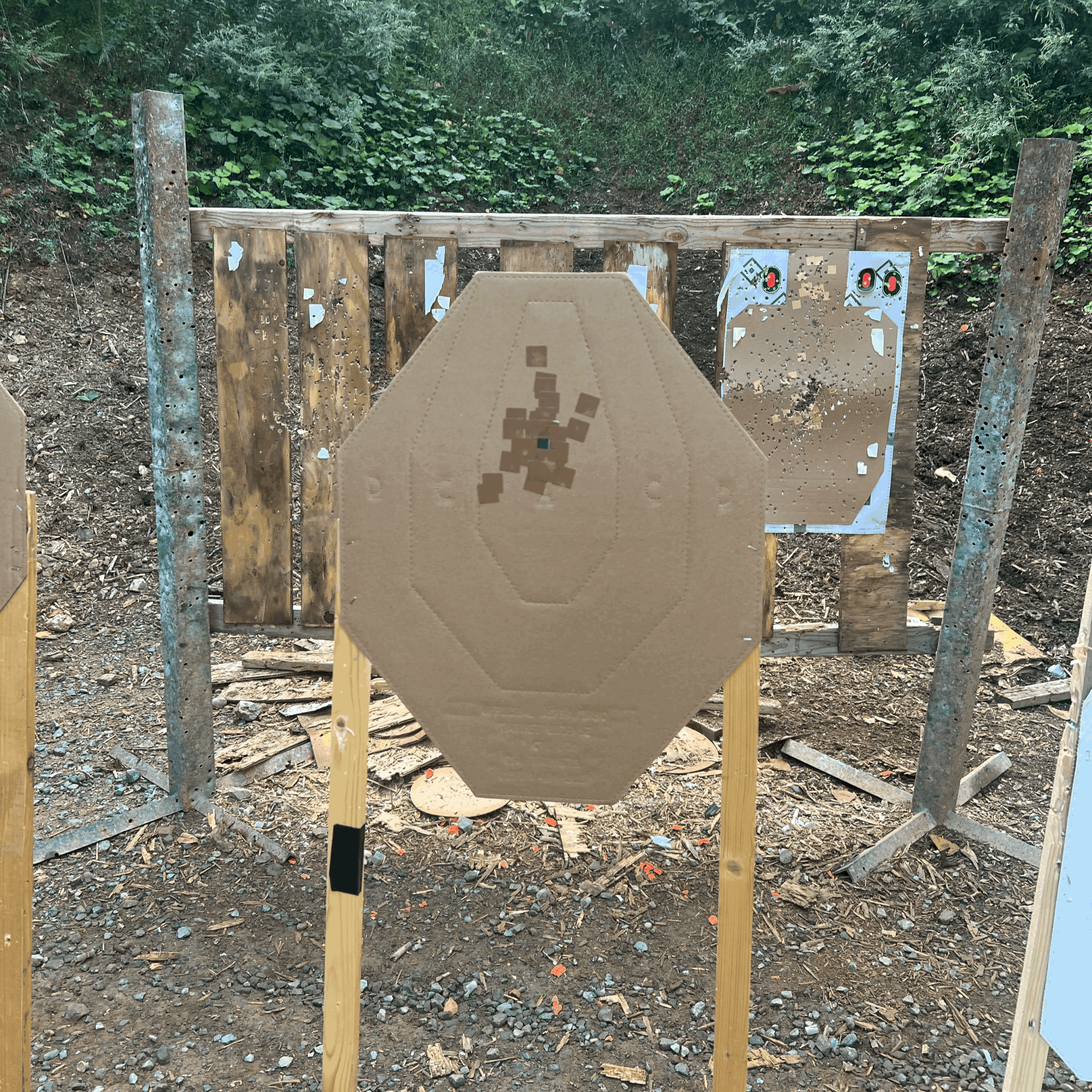
“Vision" is a broad stroke term often used in competition shooting, but not so much in tactical or defensive-based shooting. For those who’ve never been exposed to it, the term is vague and lacks detail. It’s not simply the act of aligning your sights and getting a sight picture. It’s not the passive act of “seeing” the target. Vision is a physical (seeing) and mental (processing) discipline.
It’s not necessary to go down the scientific rabbit hole to build and master this skill. At its most fundamental, you’re starting the aiming process before bringing the gun up. You simply lock your eyes in on a small spot on your target where you want to send rounds. Hold consistent grip structure and pressure. Get the confirmation needed from your sights that your gun is on target. Press the trigger. Don’t overconfirm.
With four years of performanced-based training, I know how absolutely essential it is to understand and apply this concept, whether in a match or in a defensive scenario. From an EDC perspective, anyone carrying for self-defense must be able to put accurate rounds on target at speed with a minimal amount of confirmation.
However, in my previous 10+ years experience of formal tactical and defensive-based classes, I was never exposed to this concept of “vision.” You would start the aiming process after bringing the gun up on target. There was little or no discussion about holding a consistent grip and building a consistent index, meaning time was wasted re-aiming after every shot. When shooting controlled pairs or hammered pairs exercises there was no discussion beyond “press the trigger fast.” You only hoped that the second round hit the target, because there was no conversation about how visual cues and consistent connection to the gun impacted how quickly you could react. Many defensive and tactical firearms instructors simply haven’t been exposed to this concept, don’t understand it, can’t explain it, let alone demonstrate it. And some dismiss it because of its use in performance-based practical shooting.
This is a big hole in defensive training. So for many new or less experienced shooters on the defensive training track, you may not be introduced to it. And most likely, you may struggle to understand what this means or how to execute it.
What you “see” isn’t your gun. You're maintaining hard target focus, keeping your eyes locked on a small spot on your target (physically seeing the target). This is your focal point.
What you “process” isn’t bringing your sights up to your eye target line and then aiming. Your vision should be locked on a small focal point, the place you want to put rounds. You're using your sights to confirm your index is correct. When your sights appear on your target, this is your visual cue. How quickly you can perceive this cue and react to it (mentally processing the information) dictates the speed of your shooting. This is your permission to shoot.
When “shooting your vision,” the size, distance and risk associated with a target, and most importantly your individual skill level, dictates how you engage a target. For example, open targets at closer distances can be engaged more aggressively than more challenging targets with smaller impact zones at farther distances. The trap many shooters fall into is shooting all targets at the same pace with the same confirmation.
We can break “vision” down into four discrete elements. When you are able to isolate components of a process, it’s much easier to understand what’s working and what isn’t, informing where specifically you need to focus your attention in dry fire and training. So let’s break it down into four areas that can be worked in isolation or together:
Visual discipline. Are you disciplining yourself to always look for a small spot on every target?
Visual aggression. Are you keeping your eyes ahead of the gun on transitions, moving off T1 to T2 on that final trigger break and hunting for that next spot?
Visual precision. Are you getting your sights to land precisely on the spot you've picked? Or are you losing your sights in a sea of brown?
Visual patience. Are you patient enough to get the confirmation you need for that target before you press the trigger? Not rushing shots or overconfirming.
Whether for self-defense or competition, it’s important to keep your visual cues as simple as possible. Ask yourself, “What do I need to see to confirm that my sight has returned to my focal point and do I have permission to take the shot? A flash of red? A bouncing ball? Or a stopped stable dot? To determine this, work on floating through visual cues for each target. For example, you may want a more, stopped, stable dot on mini steel. Look for a flash sight picture on an open target at five yards. For a target at 10 yards, you may find you need something between a flash of color and a stopped, stable dot.
In training, we need a way to isolate components in a process to see where we’re succeeding and failing. However, if you’re using “vision” as a catch all, you may not understand what your failure point(s) may be and therefore you won’t be able to address weaknesses in practice. It’s a skill that requires lots of reps and exploration. Using a process-oriented approach like this can help lead to better, more consistent outcomes.